Is There Any Light At The End Of The Tunnel For Reform In English Football? (pt 4)
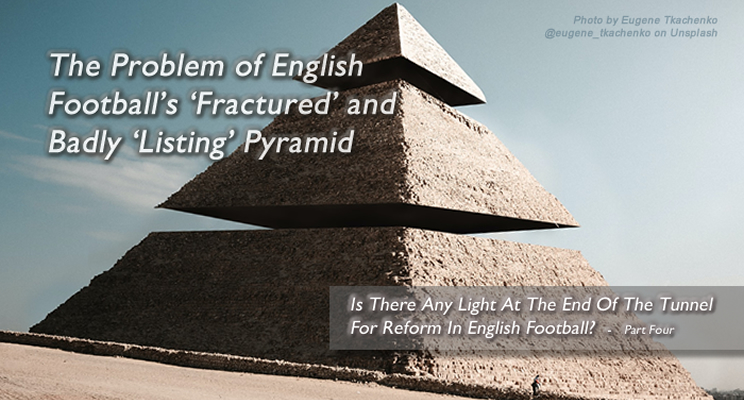
The Problem of English Football’s ‘Fractured’ and Badly ‘Listing’ Pyramid
As mentioned in the previous article (Part 3 : ‘If UK Government really cared about football reform what can they do? …… evolution, not revolution’); irrelevant of the terminology used; whether it be a regulator, commission or something else, English football needs a ‘truly’ independent body to oversee the sport if only to try and reassert some semblance of fairness, stability, integrity and TRUE TRANSPARANCY for a sport that has been developed by fans and communities over many years and many generations.
However, if you take the time to look at how the structure of English football has developed over more recent times, it is more a case of fragmentation than evolution. The diagrams below show my perspective of this fragmentation over time, and in light of this, is it little surprise that given this fragmentation the disparate entities start to look after their own self-interest irrespective of anyone else?
Yet how would an effective ‘Independent Football Regulator’ work, even with Government backing and the powers it would need to bring about effective English football governance reform, and where would it fit into English Footballs already disjointed and fractured football structures?
 1 - Historical Structure and Governance

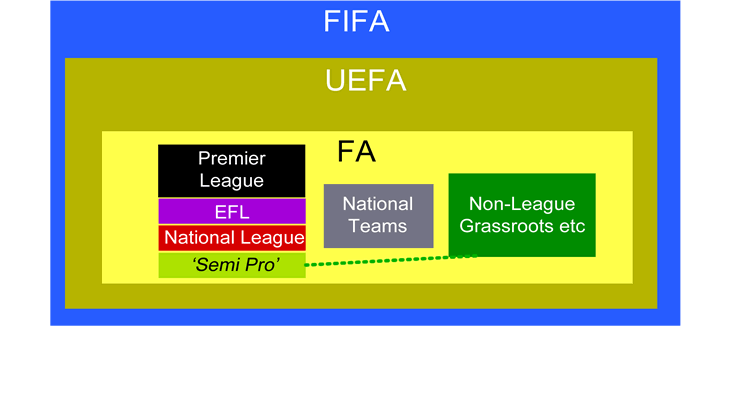
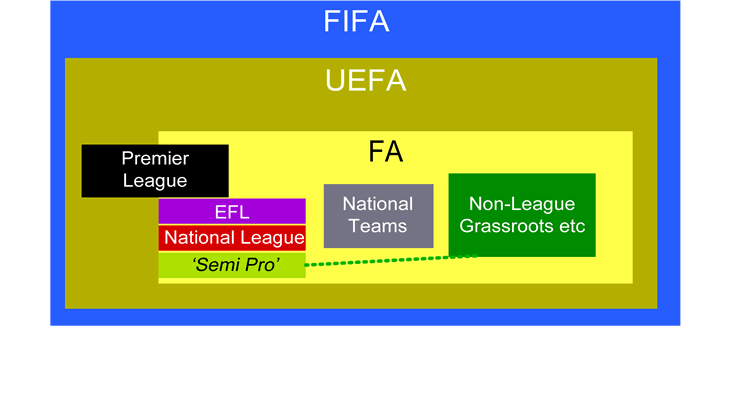
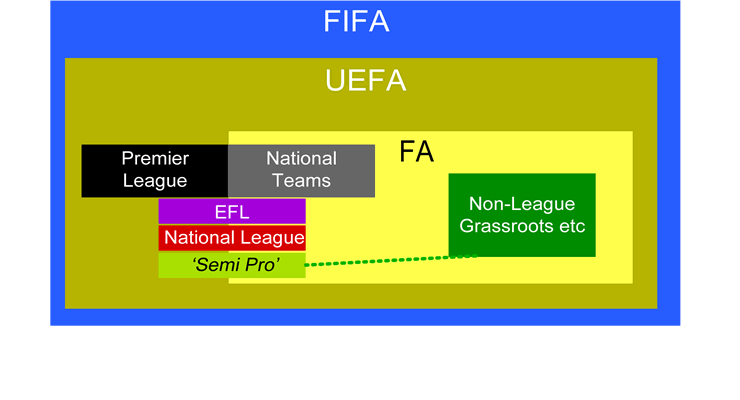
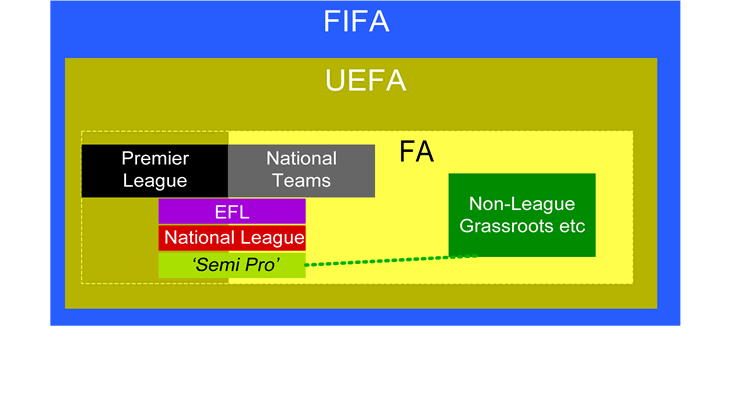
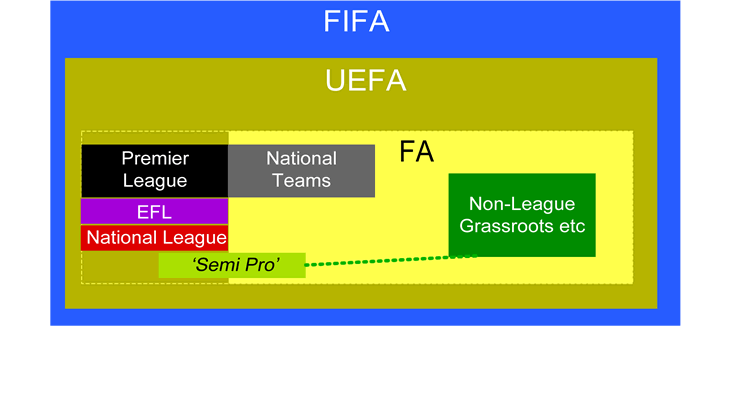

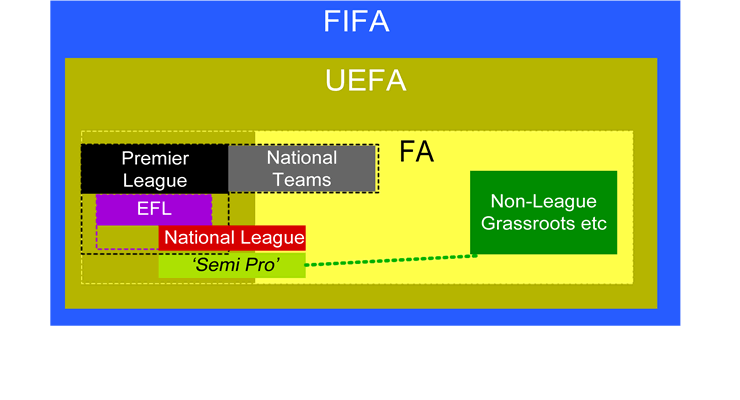
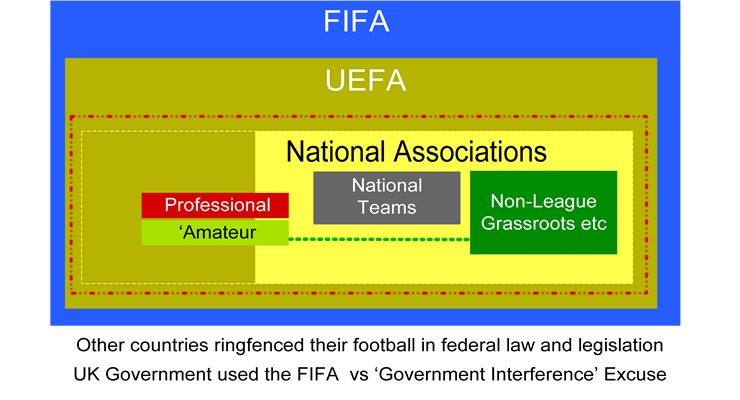
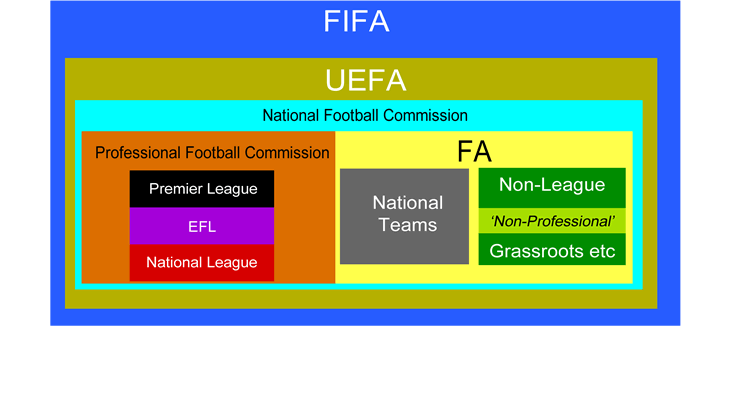
A ‘Fractured‘, Unbalanced and Badly ‘Listing‘ English ‘Football Pyramid’
Many in football laud over the English ‘Football Pyramid’ and the integrity of the pyramid, and I would agree it is a ‘crown jewel’ in our national game and has been for many years.
Yet over the years has the pyramid lost some of its integrity and become fractured if not unbalanced and unstable – benefitting the few rather than the many?
The evolution of football over recent decades from a sport of the people to a multi-billion-pound business has resulted in some struggling to survive let alone thrive, and where before there was healthy rivalry, there is now increasing selfishness.
What About the Role of The Football Association (The FA)?
I have written previously asking whether The FA is fit for purpose?, and I still believe in some ways it is (some ‘grassroots’ work and the people in those departments do phenomenal work), however in many other ways it is sadly NOT ‘fit for purpose’.
The FA for me has simply not been able to keep up with the commercial ‘juggernaut’ that has developed English football into a ‘powerful beast’ with many stakeholders (and shareholders). A lack of proactivity, creative thinking and overstretched resources over many years, has resulted in the FA sadly losing a lot of its gloss, image and reputation.
In essence it could be argued that the FA has suffered because of the commercial successes of English Football, and the last two remaining areas of interest (and influence) for The FA are ‘grassroots’ and the national ’representative’ teams.
has the influence and reputation of The FA has suffered
because of the commercial successes of English Football?
As such the ‘middle ground’ is where the FA have seemingly lost control, meaning ‘professional’ football now effectively runs itself, self-regulated by collections of ‘clubs’ (i.e., the leagues) at different levels. Akin to classes of 13-year-olds when the teacher is absent, having given up on getting the class to sit up, listen and pay attention.
As such I have long advocated that English Football needs an ‘Independent Football Commission/Regulator’ which oversees the various branches of English football. Two of which are ‘National Representative Teams’ and ‘Grassroots’, which should in my opinion still be operated under the auspices of a less stretched and more focussed FA.
This, with the FA remodelled as a ‘National Association’ rather than ‘National Governing Body’ (NGB) which I believe would benefit a large group of stakeholders (The FA included).

In addition to this, an ‘independent regulator’ would oversee the ‘professional game’ aspect in England, allowing ‘Licensed’ Leagues and Clubs to continue to operate, but not in such a carte-blanche, self-regulated and opaque manner like they seem to now.
EPPP (Elite Player Performance Plan) –
Well Intentioned or a ‘Snake Oil’?
EPPP is ‘mixed bag’ in my view, and whilst I believe the original intention was well meaning I think the whole concept has developed (and been manipulated) into something that does more harm to English football, than good.
Whilst the rigorous structures and criteria of EPPP works to safeguard and benefit the development and futures of young players (in many ways), there are factors by which the same players make sacrifices and are put at risk.
The most destructive thing about EPPP for me is the way it was arguably used as leverage of one league (the Premier League and its clubs) over other clubs and has arguably widened the gap between clubs and leagues. Despite that the purported intention of EPPP was to make things fairer for all clubs in the rewards for the development of players, this has not ended up always being the case.
has EPPP widened the gap between clubs and leagues
and destabilised the prized English Football ‘Pyramid’?
For me EPPP should be abandoned or seriously reviewed by an independent governing body, as in effect it is the ‘brainchild’ of one group that has in my opinion been imposed on other clubs (although bargained and negotiated for).
It is hard to argue against the fact that despite what may have been the original intentions of EPPP; over a longer period EPPP has widened the gap between clubs and leagues and in a way destabilised the prized English Football ‘Pyramid’.
It has even led to the adverse effect of some clubs downgrading (if not closing) their academies, which somewhat contradicts the original intention to develop better players. This degradation to academy, youth and community football development structures in turn leads to less opportunities for young players, coaches and arguably has a detrimental impact on the national team, football communities and ‘grassroots’ football.
‘What the Hell’ is Footballs ‘Grassroots’?
The term ‘grassroots’ (especially in football parlance) is one that I find particularly intriguing, if not hugely infuriating at times. It is used as a blanket term by many with no true appreciation of what they are referring to or even mean.
‘Grassroots’ seems to be used as a convenient term for football executives, clubs, media and politicians to regurgitate, to deflect on the good elements of football in contributing to a wider community.
has ‘Grassroots‘ become a misused & convenient term,
if only to deflect from football’s problems?
Yet if you ask 10 people in football (or anywhere else) to explain what exactly ‘grassroots’ football is, I would predict: a few couldn’t answer and the others would give different answers based on their role in football and the level at which they are involved.
- Is it an under-13 player not signed to a premier league club but playing in their Community-Academy Team?
- Is it a 8-year-old signed to an ambitious league 1 clubs main academy?
- Is it a young level 6 National League (n/s) player getting his petrol money and expenses paid?
- Is it a tier 8 player getting paid £200 a week plus expenses, by a generous chairman?
- Is it a ‘seniors’ walking football side?
- Is it an under 7’s community club?
- Is it even a Sunday league amateur side?
Looking back at my time studying FIFA statutes and FA Regulations for the first time, I came to appreciate that officially there is no such thing as a ‘semi-professional’ football, either you are an amateur or a professional (although I prefer non-professional to amateur, as some non-professional footballers are far from amateur in their approach and mentality, and vice versa).
And this is a definition on which the rebalancing of English Footballs ‘Pyramid’ and governance needs to draw:
Where is the line between professional and amateur (non-professional)?
….. and in the greater scheme of things this could be a very important ‘line to draw’ and definition to make for the long-term benefit and stability of English football.
For me the safest definition of ‘grassroots’ is the boundary between any entity (i.e., club) that can be labelled as having a professional element (e.g., just one paid player in addition to expenses) and those which don’t.
As such, have we reached a point where the slow permeation of player expectations through the leagues has gone too far and must stop? With below par non-league players demanding a weekly pay packet despite the club struggling to survive.
time to draw the line between professional and amateur,
there is no such thing as ‘semi-professional’ football!
By drawing a definitive line between professional and non-professional clubs, working in tandem with a licensing system for professional football clubs (as mentioned previously), some respite could be drawn for non-league clubs in declaring themselves amateur (non-professional) rather than living beyond their means in trying to be ‘semi-pro’, until their resources, assets and competitive standing determines that they may declare otherwise.
In clubs acknowledging their true status (professional or non-professional), clubs can determine what they pay players and coaching staff to expenses only (in effect a ‘cap’ of sorts) and thus safeguarding their futures. Non-professional clubs will be made eligible for grants that may otherwise have been given to those who don’t need or deserve them.
The sad fact is that there is an annoying ignorance (if not arrogance) across many clubs, owners and club officials who view themselves as ‘hard done by’. They will readily ‘plead poverty’, moan about the lack of a player salary ‘cap’ or the imbalance of money available to them compared to clubs higher up the ‘food chain’.
Yet it is these same clubs who will readily take advantage of someone lower down the pyramid and overspend on a player’s salary at the whim of the manager.
Too Late, Too Naïve or Unrealistic Football Utopia?
Over many years and more so in recent months I have heard so many ideas that purportedly will address the issues in English Football Governance and threats from the likes of a breakaway (ESL) European Super League and more clubs suffering the unfortunate (and I would say avoidable) fate of the likes of Bury and Macclesfield.
Yet sadly a lot of these are idealist views, or just too late to address the issues that are now very difficult to reverse. This largely built on a foundation of academic studies and what has gone before, rather than focussing on the current problems as well as the future ones and imminent threats.
As such in my next article I will look at some of those factors which may well work in another sector, but for one reason or another are unlikely to work in the business world of modern football. From player ‘salary caps’ and ‘relegation clauses’ to the ‘50+1 model’, and club fines to ‘luxury taxes’ of transfer spending.
>>>> Part Five (5) of this article, looks at : ‘Parachute payments, player salary caps, and fairer distribution of revenues and whether they are just nice ideas but, are they all realistic for effective football reform?
On the topic of ‘Is There Any Light At The End Of The Tunnel For Reform In English Football?‘ – part 5 asks, whether the abolition of ‘Parachute Payments’, more fiscal responsibility, introducing player salary ‘caps’, and fairer distribution of TV and league money in football are feasible. Or are they just nice utopian ideals and not realistic for meaningful English Football Reform?
<<< Part Three (3) of this article, asked ‘If UK Government really cared about football reform what can they do? …… evolution, not revolution.‘
On the topic of ‘Is There Any Light At The End Of The Tunnel For Reform In English Football?‘ – part 3 looked at the role of UK Government has to play in English Football reform, and whether adopting a Football (club) Licensing System from another European Footballing Nation could provide the foundations for many solutions for effective English Football Governance reform.